


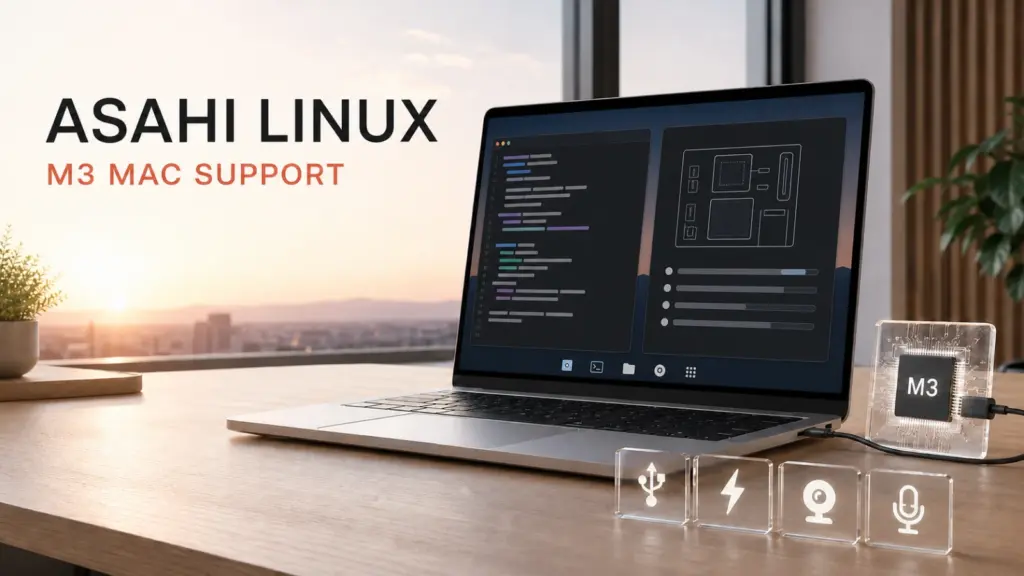
Asahi Linux is approaching an important milestone for Apple Silicon users: an official release for M3-series Macs is now described as “almost ready.” The project’s latest progress report confirms working USB 3.0 and Thunderbolt across the M3 family, along with major advances in webcams, microphones, displays and power management.
This does not mean every M3 Mac is ready for a normal installation today. M3 support remains marked as work in progress in the official installer matrix, while M4 and M5 development is at an even earlier stage. Here is what has actually changed, what remains incomplete and what prospective users should wait for.
Key takeaways
- Asahi Linux says it is almost ready to prepare an official M3-series release.
- USB 3.0 and Thunderbolt now work across the M3 family, including M3 Pro and M3 Max.
- Webcam and microphone support has advanced across equipped M3 Macs.
- M4 and M5 machines can now boot further with working NVMe and early PCIe support, but they are not installer-ready.
- Users should still wait for the project’s official release and installer announcement before treating M3 support as generally available.
Is Asahi Linux available for M3 Macs?
Not through a normal, generally available installer release yet. In its official Linux 7.2 progress report, the Asahi Linux team said it is “almost ready to cut an official release” for M3-series hardware and promised more information in the coming weeks.
The wording matters. It signals that development has crossed several major hardware barriers, but it is not the same as a release announcement. The project’s M3 feature-support matrix still marks the installer and main display as work in progress on supported M3 models.
| Hardware generation | Confirmed progress | Public-install status |
|---|---|---|
| M1 and M2 | Established Fedora Asahi Remix support across compatible models | Supported through the official installer |
| Base M3 | Core devices, USB 3, Thunderbolt, webcam and microphone work progressing | Official release is almost ready; installer still marked WIP |
| M3 Pro and M3 Max | ACE3 USB controller support, Thunderbolt and other platform work | Still awaiting the official release |
| M4 and early M5 | NVMe works; PCIe enumeration and multicore boot have progressed | Not ready for the Asahi installer |
What now works on M3-series Macs?
USB 3.0 and Thunderbolt across the M3 family
One of the largest barriers involved the USB-C controller. Macs from M1 through the base M3 used an Apple-specific Texas Instruments controller known as CD3217 or ACE2. Apple changed M3 Pro and M3 Max systems to ACE3, which communicates over an SPMI bus rather than I²C.
Asahi developers reverse-engineered the SPMI interface and found that ACE3 retains a broadly similar register layout behind the new connection. With both pieces functioning, the project reports USB 3.0 and Thunderbolt support across all M3-series devices.
That is a major practical milestone because external storage, docks, monitors and high-speed peripherals depend on the USB-C and Thunderbolt stack. It does not guarantee that every accessory or dock configuration has been tested, so compatibility validation will remain important after release.
Webcam support has reached all equipped M3 models
The webcam image-signal processor changed relatively little on M3. The M3 Max required an additional initialization message, and the driver has now been adjusted for it. According to the project, this brings full webcam support to M3-series machines that include a built-in camera.
Built-in microphone support has advanced
M3 introduced a high-frequency audio decimator that needed new coefficients and a larger initialization message. The Asahi team reports that this work now enables the microphones on equipped M3-series devices.
Audio support on Apple hardware involves multiple controllers, codecs and firmware components, so a working microphone does not automatically mean every speaker, headset and professional-audio scenario is complete. The final release notes and device matrix should remain the authority for each Mac model.
Display-controller work is approaching M1 and M2 capability
Apple pairs its AGX graphics and Display Co-Processor firmware interfaces with particular macOS releases. M3 systems target the firmware ABI associated with macOS 14.8.3. Asahi says its M3 DCP implementation is now approaching feature parity with the macOS 13.5 ABI used for M1 and M2 support.
Main-display support is still shown as work in progress in the public matrix, which is why “almost ready” should not be rewritten as “released.” Graphics and display integration must be dependable before an installer can safely target ordinary users.
Power-management work moves into the kernel
Apple Silicon does not preserve processor state during idle instructions in exactly the way standard ARM software expects. Developers added a configurable idle-loop behavior and taught the cpuidle driver to save the necessary state before entering the affected mode. Relevant patches are already in linux-next.
This work is especially important for newer chips, where incorrect handling could cause a crash early in Linux initialization. It also contributes to the longer-term goal of better battery life and reliable suspend behavior.
M4 and M5 progress is real—but much earlier
The report also describes early bring-up work for M4 and M5 systems. Apple changed the NVMe controller firmware interface in the macOS 15.x firmware bundle. Asahi developers investigated the new behavior and implemented the required support in both m1n1 and Linux, resulting in working NVMe storage on M4 and early M5 hardware.
PCIe has reached the point where Linux can enumerate devices on the bus, and a crash that occurred when enabling more than one processor core has been fixed. Developers have also restored important hypervisor tracing capabilities by emulating Apple’s Guarded Execution Framework and Secure Page Table Monitor environment.
These achievements are development foundations, not an end-user release. The project explicitly says M4 and M5 are not ready to be enabled in the Asahi installer. Many components remain incomplete, and “working NVMe” alone is not equivalent to a usable desktop system.
Video acceleration and direct scanout are progressing
Asahi previously announced preliminary support for Apple’s hardware video decoder, covering H.264, H.265 and VP9 on M1 and M2, with AV1 decoding available in the M3-era hardware block. Developers are now connecting Apple’s Interchange framebuffer format across the display, video-decoder and Mesa graphics-driver components.
This creates a path for decoded video or a full-screen application to be scanned out directly instead of being repeatedly copied and recomposed by the GPU. The potential result is lower power use and smoother playback.
It is not ready for users yet. KDE’s KWin compositor currently treats Asahi’s AGX GPU and display controller as a multi-GPU arrangement and disables this direct-scanout path. The report says KWin changes could make it possible as early as Plasma 6.8, but that is a possibility rather than a guaranteed delivery date.
What is still missing or incomplete?
The current progress should be read alongside the device-specific matrix. Depending on the exact Mac, incomplete areas can include the official installer, main display, brightness control, HDMI output, speakers, Touch ID, the Neural Engine and full graphics enablement.
- Official M3 installer support: not generally released yet.
- Main display and brightness: still marked as work in progress on M3 systems.
- Touch ID: not generally supported.
- Neural Engine: no general Asahi Linux support is listed.
- M4 and M5 desktop usability: far earlier than M3 and not installer-ready.
- Direct video scanout: development is progressing, but compositor support is pending.
The matrix can change as drivers land, so readers should check the official page for their specific model rather than treating a family-wide headline as a compatibility promise.
Should M3 Mac owners install Asahi Linux now?
Most M3 owners should wait for the official project announcement and installer support. Experimental manual procedures may exist in developer communities, but they are not equivalent to a supported release and can require recovery knowledge if firmware, partitions or boot configuration behave unexpectedly.
When installation becomes officially available, users should still back up macOS, confirm their exact model in the support matrix and read the release notes for hardware limitations. Anyone evaluating Linux more generally can follow LinuxPanda’s Linux 7.2 release tracker, its overview of confirmed Fedora 45 changes and the retrospective on 35 years of Linux development.
Why this milestone matters
Apple does not provide the documentation or Linux drivers needed to support its custom processors. Asahi Linux must understand changing firmware interfaces, security architecture, power management and peripheral controllers through careful reverse engineering, then turn that work into maintainable open-source drivers.
Reaching the point where M3 machines are close to an official release shows that the project can adapt beyond its original M1 target. Progress on M4 and M5 also establishes technical foundations for future support, even though those machines remain a long way from normal installation.
Common questions
Does Asahi Linux officially support M3 Macs today?
Not through a finished general installer release. The project says an official M3 release is almost ready, while its public support matrix still marks the installer and several display functions as work in progress.
Does Thunderbolt work on M3 Pro and M3 Max?
The Asahi Linux team reports that its new SPMI and ACE3 controller work brings USB 3.0 and Thunderbolt support to all M3-series devices. Users should still verify individual docks and peripherals after the official release.
Can Asahi Linux be installed on M4 or M5 Macs?
Not through the official installer. NVMe, PCIe and multicore bring-up have progressed, but the project explicitly says M4 and M5 machines are not ready to be enabled in the installer.
Will Asahi Linux replace macOS?
Asahi Linux can be installed alongside macOS on supported Apple Silicon systems. Whether it can replace macOS for a particular user depends on the hardware features and applications they require.
Comments