


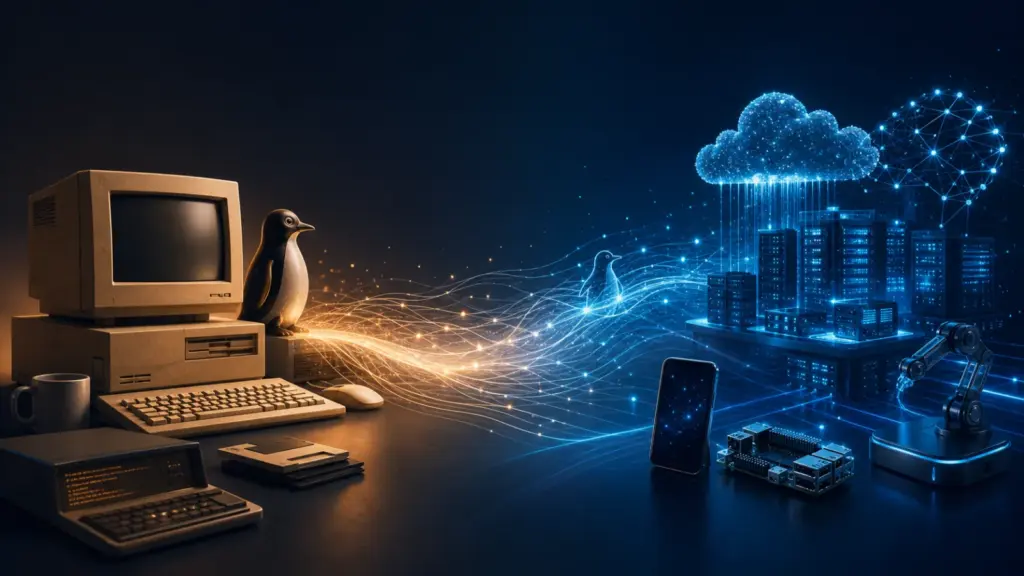
Linux turns 35 today. On 25 August 1991, Finnish computer-science student Linus Torvalds posted a short message to the comp.os.minix newsgroup about a free operating system he was building for 386 and 486 PCs. He described it as a hobby and invited other users to suggest features.
That message did not announce a polished product. It opened a conversation. Thirty-five years later, Linux sits underneath cloud platforms, Android phones, supercomputers, routers, televisions and countless embedded devices.
Key takeaways
- 25 August 1991 marks the first public announcement of the project that became Linux.
- The anniversary is different from the first Linux 0.01 source release, which followed in September 1991.
- Linux succeeded not as one commercial product, but as a shared kernel that communities and companies could study, adapt and improve.
- Its influence now extends far beyond traditional desktop Linux distributions.
The announcement that started it
Torvalds sent the original message on 25 August 1991 with the subject “What would you like to see most in Minix?” He said the system had been developing since April, already ran Bash and GCC, and was free of MINIX code. The archived message is still available as a copy of the original Linux announcement.
Two details matter when describing the anniversary accurately. First, the project was not yet presented under the familiar Linux brand in that message. Second, 25 August is the public-announcement anniversary—not the date Linux 0.01 was released. The early source remains preserved in the kernel.org historic archive.
The distinction may sound small, but it explains what is being celebrated: the moment a private experiment became an invitation to collaborate.
| Area | Linux in 1991 | Linux in 2026 |
|---|---|---|
| Starting point | A personal operating-system project | A global open-source kernel project |
| Initial hardware | 386 and 486 AT-compatible PCs | Servers, phones, PCs, supercomputers and embedded hardware |
| Development | Linus Torvalds asking a newsgroup for feedback | A worldwide maintainer and contributor network |
| Early tools | Bash 1.08 and GCC 1.40 had been ported | A vast userspace and software ecosystem |
| Current mainline | The 0.01 era was approaching | Linux 7.2 is listed as mainline by kernel.org |
Linux in seven milestones
| Date | Milestone | Why it mattered |
|---|---|---|
| 25 Aug 1991 | First public announcement | Torvalds invited feedback on his free operating-system project. |
| Sep 1991 | Linux 0.01 source became available | Other programmers could inspect and experiment with the code. |
| 1992 | Linux moved to the GNU GPL | The licence helped ensure modified source could remain shareable. |
| 1994 | Linux 1.0 arrived | The project reached its first major stable-version milestone. |
| 2008 | The first commercial Android phone launched | Linux reached a much larger consumer audience through mobile devices. |
| 2017 | Linux reached all TOP500 systems | It became the operating-system family behind every listed top supercomputer. |
| 2026 | Linux turns 35 | The project continues across cloud, mobile, edge and high-performance computing. |
This timeline is deliberately selective. Linux history also includes thousands of distribution releases, hardware ports, security changes and community debates. The important pattern is that the kernel kept adapting without becoming tied to one device category or vendor.
Where Linux is used today
Cloud servers and infrastructure
Linux became a natural foundation for servers because administrators could inspect it, automate it and adapt it to many environments. Containers later reinforced that role: most container workloads use Linux kernel features for isolation and resource control, even when developers interact mainly with higher-level tools.
For administrators, this history is not abstract. Skills involving permissions, services, networking, logs and the command line remain useful across local machines, virtual servers and cloud instances.
Android phones
Google’s Android Open Source Project states that the Android kernel is based on an upstream Linux long-term-supported kernel. Android is not a conventional desktop Linux distribution, but its kernel connection means billions of mobile devices belong to the broader Linux story.
Supercomputers and research
Linux also became dominant in high-performance computing. Its portability and ability to be customized made it suitable for specialized machines where engineers need control over scheduling, networking and hardware support. The Linux Foundation documented Linux running all systems on the TOP500 list in 2017.
Desktop Linux
The desktop remains the most visible form of Linux for many readers, even though it represents only one part of the ecosystem. Distributions now offer polished installation, gaming support and modern hardware compatibility. Our recent analysis of reported Linux desktop market-share growth shows why interest in this part of the story continues, while the confirmed Fedora 45 development changes provide a current example of how distributions keep evolving around the kernel.
Why the Linux development model worked
Linux did not become important simply because its source code was available. Its long-term strength came from a combination of open review, practical maintenance and the ability to run in very different environments.
- Shared engineering: individuals, universities and companies can contribute to the same upstream project.
- Portability: Linux expanded far beyond the limited hardware described in the original message.
- Visible development: patches, discussions and release history can be inspected publicly.
- Distribution choice: communities can combine the kernel with different software, defaults and support models.
- Practical maintenance: stable and long-term branches allow users to prioritize reliability while mainline development continues.
This model is sometimes untidy. Kernel changes still require human review, regressions happen, and distributions make different trade-offs. Openness does not remove engineering risk; it makes the process observable and allows more people to participate in correcting problems.
Linux at 35: what comes next?
Linux enters its 36th year while the mainline kernel continues to evolve. At the time of publication, kernel.org lists Linux 7.2 as the latest mainline release. LinuxPanda is following that development through our Linux 7.2 release tracker.
The next chapter is likely to be less about Linux “winning” one desktop contest and more about it remaining a dependable layer underneath changing technology. AI servers, confidential computing, new processor architectures, vehicles and edge devices all need an operating-system foundation that can be examined and adapted.
For me as a Linux administrator, the most remarkable part is the continuity. Commands, files and troubleshooting habits learned on one Linux system often remain recognizable years later, even while the hardware and workloads change completely. That practical continuity is one reason Linux has stayed relevant.
Thirty-five years after a student asked a newsgroup what people wanted from a new operating system, Linux is still shaped by people asking questions, testing answers and sharing improvements.
Frequently asked questions
When is Linux’s birthday?
25 August is widely celebrated because Linus Torvalds publicly announced his operating-system project on that date in 1991. Linux 0.01 was made available later, in September 1991, so the announcement and first-release anniversaries are different.
How old is Linux in 2026?
Linux is 35 years old when measured from the public announcement made on 25 August 1991.
Is Android really based on Linux?
Yes. Android uses a kernel based on upstream Linux LTS releases, combined with Android-specific changes. Android is not the same experience as a desktop Linux distribution, but Linux provides its kernel foundation.
Who owns Linux?
No single company owns the Linux ecosystem. The Linux Foundation confirms that the Linux trademark belongs to Linus Torvalds, while kernel development involves maintainers and contributors from many organizations and communities. Individual distributions and products have their own owners and governance.
Sources
- Archived copy of Linus Torvalds’ 25 August 1991 announcement
- The Linux Kernel Archives: current releases
- Kernel.org historic Linux source archive
- Linux Foundation: celebrating 35 years of Linux
- Android Open Source Project: kernel overview
- Linux Foundation: Linux and the TOP500 supercomputers
- Linux Foundation: ownership and use of the Linux trademark
Related history: Linux did not grow alone. Our GNU Project 43rd-anniversary explainer shows how GCC, Bash, glibc and Coreutils became part of the wider system used by many distributions.
Comments